How Dermaplaning Differs From Other Professional Facial Exfoliation Techniques
September 13, 2026Chemical Peel Aftercare in North Epping: Why Post-Treatment Skin Protection Can Influence the Overall Experience
September 13, 2026Skin Tightening in West Pennant Hills: Why Collagen Remodelling Is a Gradual Process Rather Than an Instant Result
Understanding What Really Happens During Skin Tightening
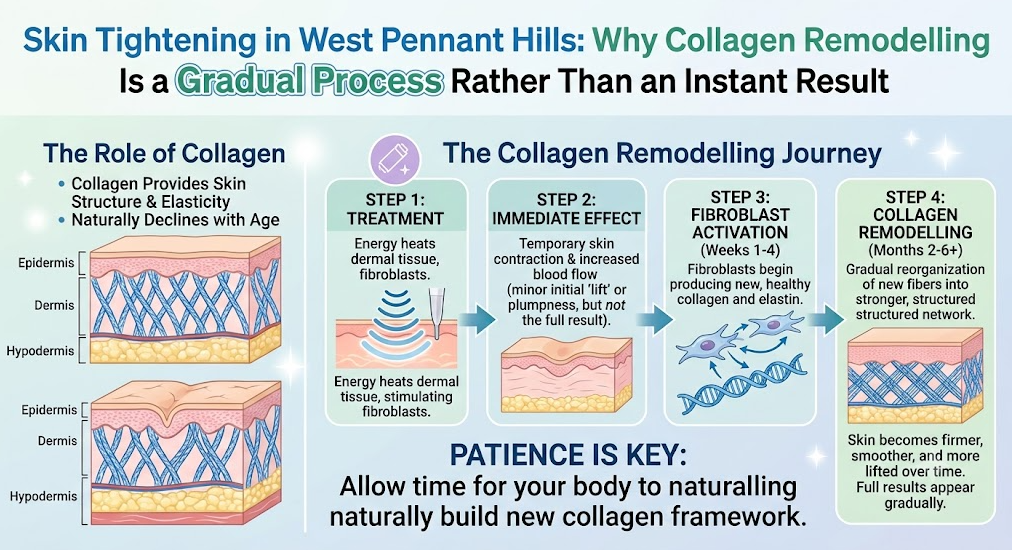
Skin tightening is often associated with the expectation of seeing a dramatic improvement immediately after a treatment, but the biology of collagen remodelling tells a different story. When the skin is treated with an appropriate skin tightening technology, the objective is generally to stimulate a controlled biological response within the deeper layers of the skin. This response can encourage collagen fibres to contract initially while also initiating processes associated with longer term collagen production and reorganisation. The visible changes therefore tend to develop progressively as the skin responds, repairs and remodels itself. Understanding this process is particularly important for people considering skin tightening in West Pennant Hills because realistic expectations can make the treatment experience much more satisfying. At Armitage Skin, we believe that understanding how the skin changes over time is an important part of making informed decisions about aesthetic treatments.
Why Collagen Matters for Firm, Resilient Skin
Collagen is one of the major structural proteins responsible for the skin’s firmness, strength and overall support. As people age, natural collagen production gradually declines, while existing collagen can become fragmented, less organised and less effective at supporting the skin. External influences such as ultraviolet exposure, environmental stress and lifestyle factors can contribute to changes in skin quality over time. This gradual loss of structural support can contribute to laxity, fine lines, reduced elasticity and changes in skin texture. Skin tightening treatments are designed to work with the body’s natural regenerative processes rather than simply placing a temporary effect over the surface. When collagen remodelling is stimulated appropriately, the resulting changes can develop as the underlying tissue gradually becomes more organised and supported.
The Difference Between Immediate Effects and Long Term Remodelling
Some people notice a degree of improvement soon after a skin tightening treatment, but an early change should not automatically be interpreted as the final outcome. Depending on the treatment technology and individual circumstances, early tightening can partly relate to the immediate response of existing collagen fibres. The skin may also experience temporary changes in hydration, tissue tension or local inflammatory activity that can influence how it appears shortly after treatment. These initial effects can be encouraging, but the deeper process of collagen remodelling generally takes considerably longer. New collagen formation and structural reorganisation are biological processes that require time rather than occurring within a few hours or days. For this reason, evaluating results too early can lead to unrealistic conclusions about whether a treatment has achieved its intended purpose.
How Collagen Remodelling Develops Over Time
Collagen remodelling involves a sequence of biological events rather than one instantaneous change. When suitable tissue stimulation occurs, the body responds through cellular processes involved in repair and structural renewal. Fibroblasts, which are important cells involved in the production of collagen and other components of the extracellular matrix, can contribute to the longer term response. Over time, newly produced collagen can become integrated into the existing tissue structure while older or damaged collagen may undergo reorganisation. This gradual process can contribute to improvements in firmness, elasticity and the overall quality of the skin. The pace and extent of these changes can differ considerably between individuals, which is why treatment outcomes should be assessed according to biological timelines rather than immediate visual impressions.
Why Skin Tightening Results Differ Between Individuals
No two people have exactly the same skin characteristics, which means that collagen remodelling does not progress identically from one person to another. Age, skin condition, degree of laxity, genetics and previous sun exposure can all influence how the skin responds to treatment. Lifestyle factors can also affect overall skin quality and the body’s capacity to maintain healthy tissue. The specific treatment technology, treatment settings, treatment area and number of sessions can further influence the expected progression of results. Some people may experience noticeable changes relatively quickly, while others may require more time before improvements become apparent. A personalised assessment is therefore more useful than comparing one person’s treatment timeline directly with another person’s experience.
The Role of Controlled Skin Stimulation
Effective skin tightening is not simply about applying as much energy or stimulation as possible to the skin. The objective is to create an appropriate and controlled treatment response while taking the characteristics of the individual and the treatment area into account. Depending on the technology used, controlled energy delivery may target specific layers of tissue to encourage a response associated with collagen contraction and remodelling. The skin then continues the biological work after the treatment session has ended. This is one of the reasons why a treatment appointment should be viewed as the beginning of a process rather than the moment when the final result is created. Careful treatment planning can help support a predictable progression while maintaining appropriate attention to skin safety and individual suitability.
Why Patience Is Part of the Treatment Process
The gradual nature of collagen remodelling is not a weakness of skin tightening treatments, but a reflection of how biological tissue responds to stimulation. A process that encourages the body’s own structural renewal cannot realistically be expected to produce every potential benefit immediately. The skin needs time to undergo cellular activity, collagen formation and structural organisation. During this period, changes may be subtle and can become easier to recognise when photographs or other consistent assessments are used for comparison. Expecting the final result within a few days can therefore create unnecessary disappointment even when the treatment is progressing normally. Patience allows the natural remodelling process to develop before the outcome is properly assessed.
Why Gradual Improvement Can Look More Natural
One reason gradual skin tightening can be appealing is that progressive changes can allow the skin’s appearance to evolve rather than producing an abrupt transformation. The objective is generally to support improved firmness and skin quality while maintaining the individual’s existing facial or body characteristics. A sudden and exaggerated change may not always reflect the biological nature of collagen-based treatments. Instead, progressive remodelling can create changes that become increasingly noticeable as the tissue develops over time. This can be particularly relevant for people who prefer aesthetic improvements that remain consistent with their natural appearance. The final visual effect depends on numerous individual factors, but the gradual nature of collagen remodelling is an important part of understanding why these treatments can produce progressive rather than instant results.
Skin Quality Is More Than Skin Tightness
When considering a skin tightening treatment, it is important to look beyond the simple question of whether the skin feels tighter. Collagen is involved in the structural characteristics of skin, so remodelling may influence aspects of texture, elasticity and overall skin quality as the response develops. Different treatments may also have different mechanisms and may be selected according to the individual’s concerns and treatment goals. Someone primarily concerned with mild laxity may have different considerations from someone focused on texture or age related changes. A thorough assessment helps determine which concerns are most relevant and what type of treatment approach may be appropriate. This broader perspective helps ensure that treatment decisions are based on the condition and needs of the skin rather than on the promise of an instant tightening effect.
What to Expect After a Skin Tightening Treatment
Following a skin tightening treatment, it is important to follow the aftercare recommendations provided by the treating professional. The skin may experience temporary sensations or visible changes depending on the treatment technology and individual response. These effects should be considered within the context of the specific treatment that has been performed rather than assumed to represent the final outcome. As the initial response settles, the longer term remodelling process can continue beneath the surface. Results are often best assessed over an appropriate period rather than immediately after treatment. Consistent follow up and appropriate skin care can also help provide a clearer understanding of how the skin is responding.
Why Professional Assessment Matters in West Pennant Hills
Choosing a skin tightening treatment should begin with an assessment rather than simply selecting a procedure based on a desired result. A professional assessment can consider skin laxity, skin quality, treatment areas, individual goals and whether a particular technology is suitable. It can also help establish realistic expectations about the likely progression of results and the amount of time required for collagen remodelling. This is particularly valuable for people searching for skin tightening in West Pennant Hills who may encounter many different treatment options and marketing claims. Understanding the mechanism, limitations and expected timeline of a treatment can make the decision making process considerably clearer. At Armitage Skin, we focus on helping clients understand the reasoning behind their treatment approach so they can make informed choices about their skin.
How Lifestyle and Skin Care Support Long Term Results
The treatment itself is only one part of maintaining healthy looking skin over the longer term. Daily sun protection is especially important because ultraviolet radiation can contribute to collagen degradation and premature changes in skin structure. A consistent skin care routine can also help maintain the condition of the skin while the deeper remodelling process develops. Adequate nutrition, hydration, sleep and other healthy lifestyle habits can support general skin health, although they cannot replace professional treatment when treatment is appropriate. It is also important to follow specific post treatment instructions because recently treated skin may require additional care. Protecting the skin from avoidable environmental stress can help preserve the improvements achieved through a considered treatment plan.
Why Multiple Sessions May Sometimes Be Recommended
Depending on the degree of skin laxity and the technology being used, one treatment may not always represent the complete treatment plan. Collagen remodelling is cumulative in nature, and some individuals may benefit from a series of appropriately spaced treatments. The decision to recommend additional sessions should depend on the person’s response, treatment goals and professional assessment rather than an assumption that more treatment is always better. Allowing sufficient time between sessions can also be important because the skin needs time to respond and remodel. Assessing the developing result before deciding on further treatment can provide a more rational approach to treatment planning. This allows the plan to evolve according to the individual’s actual response rather than relying solely on predetermined expectations.
Avoiding the Expectation of Instant Transformation
The popularity of aesthetic treatments has created an environment where immediate results are often emphasised, but biological processes do not always follow marketing timelines. Collagen production and remodelling require cellular activity, and cellular activity requires time. A person may therefore leave a treatment appointment without seeing the full improvement that will eventually develop. This does not necessarily mean that the treatment has been ineffective or that the skin is not responding. Instead, it can mean that the most important part of the process is still occurring beneath the surface. Understanding this distinction can help people approach skin tightening with realistic expectations and greater confidence in the treatment journey.
A More Informed Approach to Skin Tightening
Skin tightening is best understood as a process of encouraging the skin to improve its structural support over time rather than simply producing an instant visual effect. Collagen remodelling involves a sequence of biological responses that can continue after the treatment session has finished. The visible outcome can therefore develop gradually as collagen is produced, reorganised and incorporated into the surrounding tissue. Individual factors can influence both the speed and extent of this process, making personalised treatment planning especially important. For people considering skin tightening in West Pennant Hills, understanding these principles can provide a more realistic framework for evaluating treatment options and expected outcomes. With the right assessment, appropriate treatment approach and patience, the gradual nature of collagen remodelling can become an important part of achieving natural looking improvements in skin firmness and quality.
Looking at the Long Term Picture
The most useful way to evaluate skin tightening is to consider the condition of the skin over time rather than focusing exclusively on what is visible immediately after an appointment. Gradual changes can provide a clearer indication of how the tissue has responded once the initial effects have settled. Consistent photography, professional reviews and realistic expectations can help make these changes easier to recognise. The goal should be to understand what the treatment can reasonably achieve and how the skin is expected to progress during the remodelling period. When treatment is approached as a biological process rather than an instant cosmetic correction, the timeline becomes easier to understand. Ultimately, informed decision making, appropriate professional guidance and patience are central to appreciating the full potential of collagen remodelling.